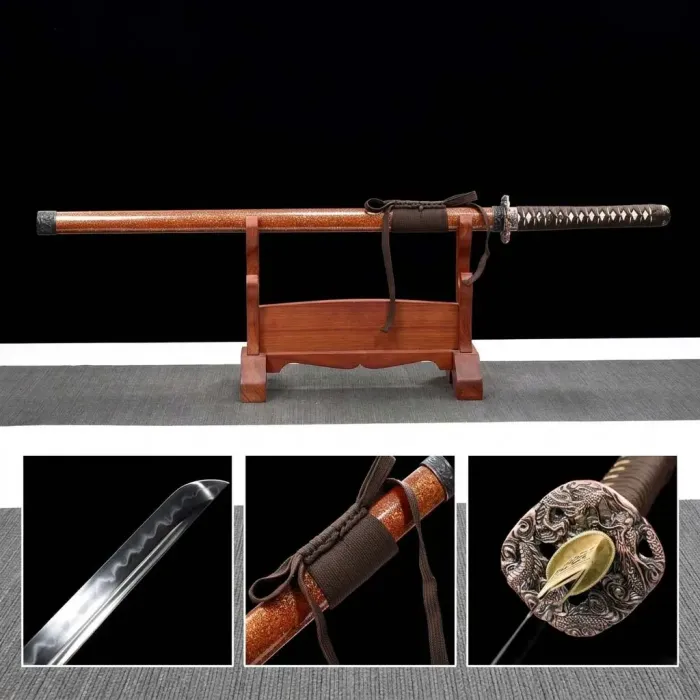
An time-honored nihonto exists as a exquisite piece of craftsmanship, but say you want to communicate your exclusive aesthetic? Tailoring your weapon is a significant journey, allowing you to assemble a truly exceptional piece. From the haft wrapping and habaki to the protector design and heat mark, each aspect offers a chance for bespoke design. This exploration delves into the space of katana customizations, providing tips for both beginners and proficient enthusiasts searching to inscribe their impression on the time-honored art of the samurai.
Freshman's True Handiwork
For enthusiasts ready to embark on the advantageous journey of samurai sword fighting , 1060 steel katanas furnish an remarkable entry point. This specific grade of structural steel meets a golden mean between economical cost and performance . While not as hard as premium steels, 1060 permits a acceptable level of knife work , making it tailored to apprentices to enhance the preliminaries of sword maintenance and appreciate the elegance of traditional Japanese weaponry. It’s a wonderful choice for developing experience without the budgetary burden of more sophisticated steels.
10# Steel Katanas : Balancing Performance and Affordability
Satisfying specialists seeking an authentic cutting instrument experience without overwhelming the capital constraint , T10 substance katanas represent a beneficial option. These daggers offer a marked improvement in resilience compared to cheaper alternatives, exhibiting decent edge retention and fair flexibility for initial hacking techniques. While not rivaling the excellent characteristics of top-tier steels like T100 or folded metal , T10 provides a effective blend of effectiveness and reasonableness , making them a favored choice for newcomers and those on a modest salary .
Exceeding the Steel : Customizing Your Weapon's Components and Grip
As the finished steel is undeniably the focal point of a katana, truly boosting its presence lies in the careful customization of its details and handle . This operation allows admirers to showcase their special flair . Consider the ample possibilities: menuki - decorative adornments that bring visual interest ; the hamon casings – often finely sculpted ; the tsuka core itself, wrapped in time-honored ito twine ; and the fusa terminal , which can be crafted from various resources like bullion or nacre.
- Pick patterns that harmonize with you.
- Delve into with diverse composites .
- Focus on strength for a lasting influence .
The Allure of the Katana: History, Craftsmanship, and Steel
This traditional armament possesses a exclusive allure, steeped in times of Nippon's history and legacy . More than merely a contraption of warfare , it's a embodiment of the knight ethos – a fusion of prowess and self-control . Its advancement spanned countless generations, with early arms evolving into the elegant curvature and fatal edge we distinguish today. The production involved is truly remarkable , requiring lifetimes of mentoring to become skilled in . The process involves a sophisticated folding of tamahagane , creating layers that improve the cutting edge’s flexibility and carving ability. Numerous schools of processing were established, each with their particular secrets and processes for achieving the perfect stability and precision - a truly grueling pursuit.
- Original Katana styles
- The importance of the traditional blade in champion culture
- Traditional smithing methods
Selecting the Ideal Steel for Your Katana Project: 1060 vs. T10
Selecting the right steel is critically important for any katana project, and the decision between 1060 and T10 can be tricky. 1060 is a popular American element, offering a competent balance of firmness and endurance, enabling it moderately easy to handle. However, T10, a Nipponese steel, typically boasts better wear resistance and can perhaps achieve a elevated decisive hardness, although it can be significantly hard to process and requires accurate katana sword heat treatment. Consider your qualification and expected effects: for a first-timer, 1060 may be a more origin, while the competent smith might prefer the enhanced properties of T10.
- Accessibility of Controlling
- Friction
- Ultimate Toughness
Unlocking the Potential: Advanced Katana Customization Techniques
Mastering the art of katana tuning extends far beyond basic whetting. Serious masters are now delving into advanced techniques to truly release a blade's hidden potential. This requires intricate work with the hamon, utilizing specialized products for differential heat treating and carefully nominating the contour of the hand guard to optimize balance and handling. Beyond purely functional customizations, artisans are increasingly focused on producing unparalleled aesthetic magnificence, through complex incising and layered varnishes that truly transform a katana into a magnum opus.
Shaping Rough Steel into Perfection: Making a 1060 Sword
The journey begins with average 1060 metal , a strong material far away the sophisticated katana it will become . Adept bladesmiths perform a complex process of integrating and constructing the unrefined steel, repeatedly tempering it and pounding it to clear impurities and form a balanced grain structure. This tedious process, often continuing for spans , builds the vital sturdiness and ductility characteristic of a authentic Japanese armament . Follow-up heat processes , including meticulous hardening and setting , are vital to achieve the sought-after proportion of sharpness, stability and elegance .- Stacking: Lowers impurities and establishes grain structure.
- Shaping: Designs the steel into the initial blade form.
- Curing: Directs the final hardness and flexibility.
The Ongoing Allure of the Katana: Detailed Survey of Metal and Enhancement
Each traditional katana stays a potent symbol embodying Japanese custom , its enticement far beating mere weaponry . Forged from tamahagane steel and frequently featuring intricate embellishments , the practice of creation itself is a hallowed art. Beyond the crucial craftsmanship, the ability to adapt a katana - from the edge marking to the shaft wrapping and fastening - provides for a honestly individual demonstration for both worshippers and participants alike. This confluence of classical steelwork and boundless personalization creates the katana's continued widespread acceptance across the realm .